Saturday, 8 December 2012

What next for 'Hacked Off' ?

What next for 'Hacked Off'? *
It's not yet over but there's every chance that we're seeing exactly the "ugly stitch-up" that its director Brian Cathcart described at the beginning of this week.
'Leveson-lite' press regulation that lacks any statutory backstop to ensure we, the public, can hold editors' and publishers' feet to the fire.
Yet another regime devised by the press, for the press that will be no guarantee of accountability once memories of phone-hacking have faded.
It might not turn out that way, of course. The arithmetics of parliament and petition might still see the interests of the public take precedence over the commercial interests of owners and publishers.
Cynical calculation
The press seems to have come a long way in the short time since Leveson published, conceding much, though not all, of what Hacked Off demanded and Leveson recommended. Enough, perhaps, to persuade that majority of the public serially disgusted at the behaviour of the press that this latest iteration of of self-regulation is good enough.
If they pull it off, it might be down to the political and fixing skills of Guy Black. More realistically, though, it derives from a cynical calculation that public memory is short and that nothing in 'Leveson-lite' will stop the press from sliding back into its old ways. Minus the blatant lawbreaking, like phone and email hacking.
Not just phone-hacking
It's worth remembering that neither Hacked Off nor the Leveson Inquiry was only about phone-hacking or other illegal activity. Nor about celebrities chafing at the downside of publicity and fame.
What was under the microscope was the habits and 'culture' of the press - serial libels, misrepresentations, intrusions, intimidation, monstering, lynching, blagging, entrapment. And the arrogant mindset that saw nothing wrong in trashing the lives of 'ordinary people' like the Dowlers, the McCanns and Christopher Jeffries. A mindset that served the public interest not at all and was calculated to turn inhumanity and vindictiveness into publishers' profits.
More than anything else, both the Hacked Off campaign and the Leveson inquiry were about bringing accountability to the last powerful, unaccountable institution in the UK.
Public or 'state'
Unsurprisingly, the press has used the 's' word - statutory - to scare us all with vague and unspecified warnings that a statutory backstop to independent regulation, the "heart and soul" of Leveson, is the start of the slippery slope to state control.
It's rubbish, of course. Nothing in Leveson amounts to statutory regulation or anything like it. Nor licensing nor state interference. What publishers and editors find so hard to accept is the idea that anyone should ever have the temerity to call them to account, to insist that they explain their decisions and are as transparent as they demand other institutions should be.
The idea that we, the public, should have that power - a power that only statute can ensure and protect - is unthinkable.
But as this excellent leader in The Observer on 2 December argues, it's misleading to identify public accountability with state control or interference as the press has done:

"Britain is not very good at distinguishing between the idea of the state and the public ... The public is the space to which every citizen has equal access. It is underpinned by the rule of the law, freedom of speech, tolerance and the spirit that differences should be settled through argument, inquiry and ultimately the ballot box. 
 The sharp differences that have emerged since the publication of Leveson have at their heart this failure of understanding."

Similarly, the difficulties of framing any statute have been wildly overstated.
In essence, it's about two simple ideas; 'there will be a body that regulates the press that is independent of the press ...' and 'there will be an auditing body, independent of government and parliament and accountable to the public, that oversees the work of the regulating body ...'
The principle isn't so hard. And when it's framed like this, it's easy to see how that auditing body, established by statute, is essential to ensure enduring public confidence.
If ...
The Prime Minister's calculation in dismissing the "heart and soul" of Leveson so peremptorily was a simple one, made by a politician whose questionable closeness to News International was something the press never cared to illuminate for us.
Come May 2015 when a mere one or two percentage points might be the difference between a Tory majority government and defeat, the editors of The Sun and the Daily Mail will, David Cameron hopes, carry far more weight than Gerry McCann or Chris Jeffries.
He might still have miscalculated and national newspaper editors might yet snatch defeat from the jaws of victory.
But if the worst happens and the press is left once again to account for itself to itself, Hacked Off and/or its parent the Media Standards Trust (MST)might well have to assume the role that Leveson had in mind for a statutorily backed auditor - ensuring self-regulation doesn't mutate into self-interest and self-regard as it did with the discredited Press Complaints Commission.
There will clearly have to be some body - more than one, ideally, if in the end there's no single auditor backed by statute - that scrutinises press regulation, investigation and sanction on behalf of the public. That critiques any new code and witnesses its application. That can demand action, if only by virtue of public pressure.
In the UK, academe and organisations like the MST and the Reuters Institute* - to name but two - have done good work but have had limited effects on press standards, in part because they're not the kind of organisation that could ever capitalise on public opinion and mood.
Making trouble   
For all sorts of reasons, Hacked Off showed how the public's ill-focused disgust with the press could be focused and organised. That we, the public, did indeed care about what journalists were doing in our name, wanted them to be accountable to us and behave in a way that was broadly consistent with normal human values.
Should it come to it, Hacked Off needs to make trouble for the new regulator, asking the questions and demanding the answers any law-backed auditor would. Requiring, with public if not statutory authority, that the press account for itself.
And, bluntly, if they don't do it ... who will?

*Declaration of interest: I was one of the founder members of 'Hacked Off' and chaired the Reuters Institute for the Study of Journalism's roundtable that formulated its submission for the Leveson inquiry - a submission that, among other things, proposed the fast track resolution system that is one of Leveson's key recommendations and an idea accepted by most national newspaper editors.  

Sunday, 11 November 2012

An intriguing thought

It might have slipped your mind briefly in the last twenty four hours - it had mine - that key BBC News executives had ‘recused’ themselves during Nick Pollard’s inquiry into the Newsnight Savile investigation.

That’s to say, they’d taken themselves off the pitch for anything to do with the shelved investigation and/or further Savile allegations.

I'd assumed that this recusation applied only to matters Savile. But a senior BBC executive told me this morning that those who'd recused themselves - and that included the former DG George Entwistle - interpreted their quarantine as excluding them from any editorial decision making on any further allegations of child abuse.

Remember, George Entwistle told John Humphrys in the fatal Today interview that the Newsnight McAlpine film had been signed off “at management board level” – normally it would have been what’s known in the BBC as the News Board, usually chaired by the Head of News, Helen Boaden. The BBC Trust Chairman, Lord Patten, told Andrew Marr something similar.

Now, the line of command upwards from Newsnight prior to the Savile row was: Editor of Newsnight (Peter Rippon) - Head of News Programmes (Steve Mitchell) - Head of News (Helen Boaden) - Director General (George Entwistle)

Once Rippon had "stepped aside" and other News executives 'recused' themselves, that line of command on 'recused' matters became: acting Editor of Newsnight (??) - Head of Newsgathering (Fran Unsworth) - Director of World Service (Peter Horrocks ... replaced during Horrocks's annual leave by Adrian van Klaveren, the controller of R5Live) - Director of Audio and Music (Tim Davie). That meant Davie was effectively editor-in-chief on 'recused' matters.

It appears from what I learnt this morning that the Newsnight McAlpine film was judged to fall within the 'recused' area ... and that, therefore, it was dealt with by the temporary management structure and not the regular one.

If that's the case, then many of the questions over the McAlpine film that John Humphrys fired so effectively at George Entwistle - who declined to raise the complications of 'recusation' as any defence - might just as properly be put to the new acting Director General, Tim Davie.

Thursday, 25 October 2012

Savile ... and the Panorama pitch


The BBC confirmed to me this morning that the Newsnight ‘Savile’ producer, Meirion Jones, pitched his investigation to Panorama on the same day he pitched it to Newsnight.

The BBC says that in a short, five or six line email to the Panorama editor Tom Giles on 31 October 2011 - two days after Jimmy Savile had died - Jones wrote that he believed he could gather evidence of Savile’s abuse at the Duncroft Home where his aunt had been headmistress. 

The email to Giles was, as he later explained, "to keep his options open”.

Jones had already had one meeting with the Panorama editor to talk in general terms about the possibility of working on longer investigations. And they were due to meet again – but after Newsnight editor Peter Rippon had given Jones and reporter Liz MacKean the green light to start collecting evidence, that meeting never happened.

There was no further contact between the Panorama editor and Jones until pre-programme publicity for the ITV programme Exposure:the other side of Jimmy Savile began to appear in the press. There is no suggestion that Giles looked at any of the evidence gathered for Newsnight nor that he was aware of the detail of the investigation.

Important questions

On Tuesday, BBC Director General George Entwistle told MPs: "we do have to address this question of what comes of journalism that doesn't necessarily result in immediate output".

It's likely that former Sky News executive Nick Pollard will want to know why, when Newsnight producer Jones had an ‘open channel’ to Panorama, he and his reporter did not take their evidence to Giles in December 2011 to make a formal pitch for a half-hour slot.

Soon after the Newsnight investigation was shelved, well-sourced leaks suggested it had been dropped because of pressure from above, to avoid embarrassment over the BBC's planned Christmas Savile tributes and to protect its reputation.

Sunday, 14 October 2012

Newsnight, Savile and the DG's real and present danger

I hope that BBC DG George Entwistle’s decision to hold those “internal,independent and forensic” inquiries doesn’t turn out to be his biggest and last as Director General.
Especially the inquiry into Newsnight’s decision to pause its investigation into Surrey police and those allegations that they and/or the Crown Prosecution Service mishandled abuse complaints made against Jimmy Savile.
It’s an inquiry born out of frustration. And it’s easy to see where the frustration comes from.
In spite of the clearest possible denials from all concerned, the suspicion persists that he or another BBC "boss" pressured Newsnight editor Peter Rippon to “pull” a ten or twelve minute film detailing Savile's crimes. 
That's not what happened and, unsurprisingly, there’s never been any evidence that it did. Anyone sane who knows the BBC would have to conclude that Rippon shelved the investigation for sound editorial reasons, not through pressure from above.
Exactly as he and everyone else involved have insisted throughout. Exactly what the Newsnight inquiry will find. 
But that might be the start and not the end of the new DG's real problems. 
Suspicion
Let’s be clear what the suspicion, the allegation, amounts to.
It’s not that Newsnight’s decision to shelve its inquiry was a bad call. Nor that the editor was excessively cautious, influenced by nods or winks or made a decision he thought his bosses wanted with one eye on his career. Though, as it happens, none of that's true either.
Here’s how the Daily Mail, put it: 
“A Newsnight report was due to be screened in December, two months after Savile's death, but was pulled by bosses … attempting to cover up the allegations in an effort to protect (the BBC’s) own reputation.” (My emphasis)
OK?
Once more just to make sure; the important bits anyway: “ …pulled by bosses … attempting to cover up the allegations in an effort to protect (the BBC’s) reputation”.
Got it?
Tabloid priorities
Now, it’s worth saying from the outset that the very tabloids and journalists who've frothed over ‘what must have happened’ at the BBC signally failed even to contemplate let alone launch any investigation of their own into Savile.
If the public record is anything to go by, only one tabloid editor, Paul Connew, ever had the courage  to go after Savile and to explain why nothing came of it.
When he was editor of the Sunday Mirror, he wanted to publish the “credible and convincing” testimony of two of Savile’s victims but was lawyered out.
That was back in 1994 since when, apparently, no other tabloid editor ever lifted a finger to investigate the rumours that were rife in what we used to call Fleet Street. Presumably they were all too busy hacking phones, libelling the McCann family, lynching Chris Jeffries, entrapping the witless and stalking nineteen year old girls
Not even when Savile had died and the risk of libel had passed away with him was there any flicker of interest from the press. Were their safes not full of witness testimony waiting for their briefs' green lights? Apparently not.
Instead, just as Newsnight was ramping up its investigation, the same tabloids that have been spitting outrage at the BBC in the last week were lionising Savile, much as they had during his lifetime, re-running the kind of uncritical profiles that had done as much as anything at the BBC to elevate him to the ‘national treasure’ status he used so effectively to enable and shield his abuse of young women.*
Editorial decisions
The Newsnight investigation was not as the press coverage over the past week or so has portrayed it. Almost every assumption that's been made about it is wrong.
** Update 22/12/12: in the light of the BBC's statement this morning, it's clear that the conversations, statements and accounts on which I based this blog were not complete.** 
For instance, the Newsnight investigation was never into Savile’s criminally abusive activities per se. It was triggered by the charge that Surrey police had dropped a 2007 investigation into 40 year old abuse allegations because Savile, by then, was too old and frail.
Nor was there ever a cut, ten minute or - depending on your reading choice - twelve minute film ready to go that was "pulled". When the Newsnight editor paused the investigation, it was still at the evidence gathering stage ... evidence he was beginning to have doubts about.
In other words, there was nothing to "pull" - there was an investigation in progress and it had hit a brick wall.
There was no script, even, in spite of what's been reported in the press. There was a 'wish list', an ideal script that set out what the investigating team hoped to be able to prove. But it was a catalogue of aspirations some distance beyond what could be supported by the evidence anyone had actually gathered. It's normal, incidentally, to have a wish list like that - something that everyone can work from that sets out what you'd need to be able to prove to get an investigation on air.
There was little more, in fact, than the rushes of one interview with the investigation's 'star' witness/victim, Karin Ward, and a clutch of telephone conversations with other women apparently echoing her allegations.
One was with 'Fiona' who went on to give evidence to the ITV expose.
'Fiona' claimed to have a letter from Surrey police setting out how they’d decided not to pursue her allegations against Savile because of his age and frailty. It would have been crucial corroboration but, in spite of several requests, she failed ever to produce it to the Newsnight team. The Mail on Sunday has now reported evidence that the letter is a "fake".
There were other question marks, too, over the 'corroborating' testimony. How it had been gathered and whether the women's connections via a social networking site had had any influence on their testimony, serious and credible though it seemed to be.
Denials
But there was more.
When the programme put the allegation to the Crown Prosecution Service - that Surrey police had dropped their investigation because of Savile's age and frailty - they denied it point blank.
The CPS said that one of their lawyers had reviewed the Surrey police investigation and advised them to take no further action because of “lack of evidence”.
They told Newsnight that:
"As this is the case, it would not be correct to say that his age and frailty was the reason for no further action being taken."
There was nowhere for the investigation to go - certainly not in the time before the programme came off-air for its Christmas break.
But it was neither "pulled" nor "dropped". It was paused, shelved for sound editorial reasons and those alone. And without pressure, direct or subtle, from above.
Danger
The danger for the DG is that the Newsnight inquiry will establish exactly all of this ... and to the satisfaction of all but the most eye-swivelling.
Danger, too, that it will show exactly what Entwistle has insisted all along. That as Head of BBC Vision and responsible for the network planning to run the Savile tributes, he had only a vague awareness of the Newsnight inquiry. That he, quite understandably, kept at arms length from what was happening in another BBC division ... precisely to avoid allegations of interference.  
That will turn the Newsnight question on its head.
From ‘why did Newsnight shelve its investigation?’ to ‘why didn’t the Head of Vision shelve the tributes once he knew that a BBC programme – or indeed any other part of the media – was finally investigating Savile?’
That's the real and present danger to the BBC and to its DG.

*Update: I'm grateful for a tip from Richard Fletcher, the editor of Telegraph.co.uk, pointing up an article in The Lawyer back in 2008 which reported that Savile began legal action against The Sun after articles linking him with Haut de Garenne, the Jersey children's home.
According to The Lawyer, The Sun carried a photograph of Savile allegedly visiting Haut de Garenne and followed it with "a series of articles. One asserted that Savile was unwilling to assist with the police investigation and another that he admitted having visited the home". 
The Sun also criticised Savile for being unprepared to “go some way to fixing it for the victims”.
I agree that this makes The Sun's post-mortem tributes to Savile even more extraordinary.
  

Thursday, 27 September 2012

Harsh Realities

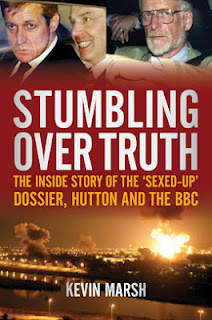
I'm new to this lark - so the whole business of promoting a book is a revelation.
I've seen it from the other side, of course, as a programme editor. Now, it's my turn to be output fodder.
I suppose anyone who's ever written a book, especially one that has six months' worth of research in it as Stumbling Over Truth has, just wants to get it out there and people to read it. All of it ... and (totally unrealistically) with the same weight on every word that you placed there when you wrote it.
But, of course, delivering the manuscript is only the start of it. Nor is the boxes of freshly minted book arriving in the publisher's office the end of it.
Maybe there'll be a serialisation? Not for Stumbling Over Truth, sadly, so you'll have to buy it to read it. But you know there'll be the round of signings and panel discussions and media interviews. Reviews and, you hope, a bit of a buzz on blogs and Twitter.
But most of all, you want people to read it.
An odd kind of book
Of course, Stumbling Over Truth is a slightly odd kind of book. It's part personal account - why and how I put Andrew Gilligan on air on 29 May 2003 with Dr David Kelly's allegations that the government's September 2002 dossier had been "sexed up".
It's part an almost historical account, derived from the mass of government documents released and leaked over the past decade, of how the September dossier was written ... an account that's some considerable distance from the conclusions Lord Hutton came to in January 2004.
And it's part a political book. An account from the inside of what it was like to be on the receiving end of New Labour's obsessive exercise in "truth creation" - Peter Mandelson's phrase, not mine - for the best part of a decade.
The three parts are linked, honest. But however odd your book might be you want people to read it.
Many different approaches
Of course, any book that touches on the Iraq war, Tony Blair etc is launched into a world where most people already know what they think and aren't likely to have their opinions changed by any new account ... even one that contains information they hadn't been able to consider before.
And so it was that Blair ultra-loyalists attacked me even before Stumbling Over Truth had been published - criticising the book they imagined I must have written rather than the one I actually had.
One review was more about the reviewer than the book - though thinking about it, many reviews often are. And one journalism professor seemed to think I was too close to events to have written the book in the first place - a slightly bizarre argument that, I confess, I struggle to understand.
Then the panel discussions. One was a little too "free flowing" and, in the end, not much to do with the book; another was very much tighter but still seemed to me to focus on the parts of the book that were the least important and interesting.
Interviews
Something similar was true of the interviews.
The chunkiest, with Steve Hewlett of BBC Radio 4's The Media Show - it's due to be broadcast on Wednesday 3 October at 1630 - focused largely on my decision to broadcast Dr Kelly's allegations, the management of Andrew Gilligan and the BBC's perception of the row with Alastair Campbell.
All interesting stuff and new - some of this is the evidence that Lord Hutton decided not to hear. But it's almost impossible now to separate it from hindsight. I tried very hard to do that in the book but it took a lot of context and background, the kind of thing that can never really make it into an interview by virtue of the simple fact that a book chapter is several thousand words, an interview several hundred.
Pity, too, that we never touched on the real meat of the book - what Lord Hutton could have discovered about Dr Kelly's allegations had he been more curious. And what it was that motivated Dr Kelly to blow the whistle on the September dossier to several journalists.
More to come
More interviews today and next week - two with non-UK broadcasters whose audiences, my hunch is, have even less background from the time than British viewers and listeners. Not quite sure how I'll deal with that. One thing is certain - the fine detail, the arguments over the precise use of words is almost certain to be dulled.
Can't be helped.
The big lesson from all of this is, I suppose, the obvious one.
As you write a book, you sculpt and shape your prose to say as precisely as you can exactly what you mean. You balance its parts to try to indicate what you think is most important and what's less so. And you try to build some kind of narrative, make connections that you hope are revealing.
But as you read one, the author's careful phrases - whole chapters, indeed - fly by barely noticed. You bring all your own preconceptions to the words on the page and those preconceptions prove as resistant as you choose them to be.
For you, the author, much of what you wanted readers to take away they leave behind and those with the will to do so raid the odd sentence and paragraph and give them a meaning the opposite of everything you intended.
And you wonder why you bothered, wondering at the same time what your next book is going to be about.  

Wednesday, 12 September 2012

Are we nearly there yet?

Are we nearly there yet?
And so, I guess it will go on ... (are we nearly there yet).
Here's what John Rentoul has replied to my reply to his reply to my book that hasn't been published yet and which he hasn't read but promises to:
"For those who do not remember, Gilligan made three allegations in the scripted version of his report on 29 May 2003 -
• that the dossier was, in words attributed directly to Gilligan’s source, “transformed in the week before it was published, to make it sexier”;
•that this transformation “took place at the behest of Downing Street” – Gilligan’s words paraphrasing his source, and elaborated by him in the Mail on Sunday, 1 July 2003, putting Alastair Campbell’s name in his source’s mouth;
•the forty-five minutes statement, in words attributed to Gilligan’s source, “was included in the dossier against our wishes, because it wasn’t reliable; … we believed that the source was wrong. Most people in intelligence weren’t happy with the dossier, because it didn’t reflect the considered view they were putting forward”.
John goes on to remind us that:
 "The Hutton inquiry found that the dossier was not “transformed” in the last week. Nor was it true that “most people in intelligence” were unhappy either with the forty-five minutes point or with the dossier generally. The intelligence services corporately, in the form of the Joint Intelligence Committee, approved the dossier and approved the wording of the forty-five minutes point, however much a few individuals at a lower level, including David Kelly, may have disagreed with its inclusion."
Where to start?
I know it's hard ... but look, let's try to deal with what is ... not what we'd like to be.
In the last week of the dossier's production, the JIC's downbeat conclusion was dropped (a Downing Street staffer first suggested this, followed by an FCO spin doctor - suggestions finally "agreed to" by Alastair Campbell, as he records in his diary).
At the same time, Campbell and Blair decided to add a foreword, drafted by Campbell, which was significantly more alarming than the excised conclusion. Sadly, for those who would deny it, the documentation is unequivocal that this "sexing up" (if no other) happened in the last week of the dossier's production.
Meanwhile, in that last week the intelligence analysts were trying as hard as they could to get the 45 minute claim taken out of the dossier or, if that wasn't possible, to ensure that the reservations they and others in intelligence had about it were included alongside the stark claim.
Other "transformations" in that last week included changes to the text made at Jonathan Powell's and David Omand's suggestions and the excision of the word "programmes" from the dossier's title, "transforming" it from "Iraq’s Programmes for Weapons of Mass Destruction" to "Iraq’s Weapons of Mass Destruction".
All these changes - made at Downing Street's behest - happened after the JIC members had "silently" signed off the text of the dossier ... that's to say, they never met as a body to approve the text. That text was circulated on the understanding that members would cry foul if there was anything there to which they objected.
Wording
They didn't object. But as it happens, the man who mattered most - Sir Richard Dearlove - cared little about the actual wording of the dossier - he made that clear from the outset. Indeed, he delegated the final read of the text to a subordinate.
He cared principally, and quite rightly, that nothing in the dossier should jeopardise his agents or operations.
Contrary to John's assertion, he thought the wording was a matter for the Prime Minister, his staff and the JIC chairman, John Scarlett.
Irrespective of Lord Hutton's conclusions - and I explain at length in the book why he was mistaken - the only facts we have argue strongly that the dossier was, as Dr Kelly alleged "“transformed in the week before it was published, to make it sexier” and that "transformation ... took place at the behest of Downing Street".
Fine to believe that was the right thing to do - not so fine to pretend it didn't happen and that what Dr Kelly told Gilligan and others was wrong.
Reliable?
As to the 45 minute claim, Dr Kelly reflected to a number of journalists - not just Andrew Gilligan - the view throughout the intelligence community that the 45 minutes claim "wasn't reliable". We now know beyond argument that Dr Kelly was correctly reporting what everyone in intelligence, from Sir Richard Dearlove down, knew of the claim's limitations.
The JIC drafting team struggled with the intelligence analysts through several iterations of the wording of the claim - but in the end, the decision was made to include a cropped version of the intelligence in a wording that gave the public no hint of those limitations.
And those who decided to do that knew what they were doing - again, anyone is at liberty to think it was the right thing to do but not to assert that it didn't happen.
Now ... this is getting really rather dull and I'm getting slightly embarrassed at the number of times I'm finding myself saying 'read the book'.

Tuesday, 11 September 2012

Why you should read the book before you review it


It’s hard to know what to make of John Rentoul’s blog that tells you what to think about my new book and the Blair government’s September 2002 dossier.
Unfortunately, I've never read much of John’s work – though I do follow him on Twitter. From that and from the comments on his blog, I infer he’s got a bit of form when it comes to the former Prime Minister and the war on Iraq.
Perhaps I shouldn't be as surprised as I am that he feels able to tell us what to think about my book without being troubled by actually reading it.
Very few have yet. As I write, the ink is still drying at the printers.
Serious libel
However … I’m intrigued that John calls Dr Kelly’s allegations about the September dossier “one of the most serious libels in political history”. That’s quite a charge which, I’m sure, he can substantiate.
Or perhaps not – as we now know, Dr Kelly was correct in every particular.
John is wrong, too, about more or less everything else he assumes I say in the book. 
Absolutely right
As it happens, I don’t argue that I was only “sort of right" and that "Tony Blair and Alastair Campbell were totally wrong”.
I do argue that I was absolutely right to broadcast Dr Kelly’s allegations, though I had no agenda of my own in doing so other than to lift a small corner on the truth of the September 2002 dossier.
As for Tony Blair and Alastair Campbell, I think I’ll disappoint a lot of those who want to ‘prove’ both were "war criminals" who “lied” to take the country into an “illegal war” etc etc.
I don’t argue, as did Desmond Tutu, that the case for war was “premised on the lie that Iraq possessed weapons of mass destruction” - I set out the reasons in my previous blog.
John concedes that “Gilligan did not use the l-word” but then ruins what looked like it might become a promising argument by asserting that “he said, in effect, that the Government ‘probably’ lied”.
That phrase “in effect” and others similar have dogged this whole debate.
Everyone thinks they "know" what "in effect" was said.
Jibe
Contrary to John’s jibe – not worthy of him, I think? – I know exactly what Andrew Gilligan said on air, what he did not and what he intended to.
You’ll have to buy the book to see the full sequence of events – but I was clear that we could substantiate every word of what Gilligan intended to say. The allegations he’d presented to me in his notes and set out in his script – yes, there was a script, by the way.
That script read:
“The first thing you see (in the September dossier) is a preface written by Tony Blair that includes the following words: ‘Saddam’s military planning allows for some weapons of mass destruction to be ready within forty five minutes of an order to deploy them’.
Now that claim has come back to haunt Mr Blair because if the weapons had been that readily to hand, they probably would have been found by now.
But you know, it could have been an honest mistake, but what I have been told is that the government knew that claim was questionable, even before the war, even before they wrote it in their dossier.”
I would challenge anyone to contest the truth of any of that.
Error 
For reasons that only he knows, Gilligan decided to do his 6.07 two-way without that script in front of him. It was an error – a huge error. His formulation of the allegation that I knew we could substantiate – that “the government knew that claim was questionable, even before the war, even before they wrote it in their dossier” – became mangled:
 “the Government probably knew that the forty-five minute figure was wrong, even before it decided to put it in”.
John writes that “this is, of course, er, not consistent with the facts, and no “probably” about it.” Unfortunately for him, it's entirely consistent with the facts.
Gilligan's mistake was not that he made this inference - it was, in fact, a perfectly reasonable inference to draw from what Dr Kelly had told him. Had he said "I think that the government probably knew ..." he would have been on much firmer ground.
His mistake - and it was a very, very serious one - was to attribute his inference to Dr Kelly. The inference, however, we now know was in line with all the facts.
I think John knows that. He certainly should.
Questionable intelligence
We now know for certain that the Head of MI6, Sir Richard Dearlove, the Chairman of the JIC, John Scarlett, the Chief of Defence Intelligence, Sir Joe French and the Chief of the JIC Assessments Staff, Julian Miller, all knew the 45 minutes claim was “questionable” – that it was single sourced, without a secure reporting line and, the analysts in Sir Joe’s service thought, both “wrong” and applicable only to battlefield weapons and not WMD.
We know, too, that the Prime Minister’s Director of Strategy and Communications, Alastair Campbell, had read the JIC assessments that went into the dossier – or at least, that’s what he told the Foreign Affairs Select Committee towards the end of June 2003.
Plausible?
Is the idea that those preparing the dossier – including Campbell – didn’t know the claim was at best “questionable” at worst “wrong” plausible?
Is it plausible that Campbell included the claim in his draft of the foreword, unqualified, without knowing its limitations?
Everyone will no doubt come to their own conclusion on both.
As to "creating the truth", I’m surprised that a political specialist like John is unaware of Peter Mandelson’s chilling interview with Katherine Viner of the Guardian back in 1997
That’s a pity. I commend it to him - there he would find that it was Mandelson not I who coined the phrase “create the truth”.
It might well be a “media-studies phrase” – I don’t know and I bow to John’s expertise in these things.
Obstruction and concealment
It’s interesting how those who prefer not to be critical of Blair and his case for war now direct our thoughts towards what they term, as John does, “Saddam’s history of obstruction and concealment”.
While that was part of the argument at the time, it was not the part of the case that argued for urgent military action.
That history - and more importantly, by the winter of 2002/3, that present - was open to differential interpretations.
Again, if John hasn't caught up with the UNMOVIC reports of early 2003 (and not the gloss that Tony Blair, Alastair Campbell and Colin Powell put on them) he should.
Hans Blix reported at the end of January 2003, for example that:
"Iraq has on the whole cooperated rather well so far with UNMOVIC ... access has been provided to all sites we have wanted to inspect ... we have further had great help in building up the infrastructure of our office in Baghdad and the field office in Mosul. Arrangements and services for our plane and our helicopters have been good. The environment has been workable."
Obstruction and concealment? Hmmm.
In any event, Saddam's history was no evidence of imminent threat … Blair’s own Chief of Staff and Foreign Secretary told him as much at the time. The Head of MI6 told me something similar, too, within days of the fall of Baghdad.
Self interest? 
Do I have an “interest in proving that what the Today programme alleged in May 2003 was "essentially" true, as John claims (how DO these journalists look inside others’ minds)?
To be picky for a moment - the Today programme alleged nothing. We reported the allegations of a credible source.
But on the substantive point - no, I have no interest in proving anything was "essentially" true nor that it was part of some "higher truth". I'm interested in showing only why I knew at the time that Dr Kelly's allegations were both reportable and part of the truth of the dossier.
Gilligan mangled Dr Kelly's allegations in one broadcast and paid the price. Was that good journalism? No. Was that one broadcast defensible? No. But of course, the other twenty or so he made that day followed the script I'd approved and he'd ignored in that one 6.07 two-way. And I stand by the allegations in that script still.
Were Dr Kelly’s allegations “false in every specific”? Well, obviously not – Lord Butler and an army of FOI researchers have left us in no doubt of that.
Was the BBC “anti-war”? Well, I can’t speak for the BBC now, but I know for a fact it wasn't at the time and I'm certain I was neither pro- nor anti-war either … except in the very broadest sense that old men like me should never find comfort in sending the young to die their deaths for them.
Advice to reviewers
Perhaps John will read my book before he writes any more about it.
I hope that when - if - he does he'll find that far from contradicting “by assertion” Hutton and Butler, I give what I believe is a reasoned account of Hutton’s shortcomings while commending Butler, the Foreign Affairs Select Committee, the Intelligence and Security Select Committee and the Public Administration Committee as the common sense they all so evidently were.
I have a feeling he'll be disappointed but am confident his spleen will live to fight another day.
As for whether New Labour had the habit of “creating the truth” – well, he'll have to take that up with Peter Mandelson not me.

Balancing the elephants

An insightful  post from Simon Wren Lewis  on fiscal reporting at the BBC and its recent report. Not much to disagree with ... except for t...