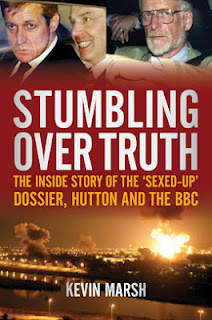
I'm new to this lark - so the whole business of promoting a book is a revelation.
I've seen it from the other side, of course, as a programme editor. Now, it's my turn to be output fodder.
I suppose anyone who's ever written a book, especially one that has six months' worth of research in it as Stumbling Over Truth has, just wants to get it out there and people to read it. All of it ... and (totally unrealistically) with the same weight on every word that you placed there when you wrote it.
But, of course, delivering the manuscript is only the start of it. Nor is the boxes of freshly minted book arriving in the publisher's office the end of it.
Maybe there'll be a serialisation? Not for Stumbling Over Truth, sadly, so you'll have to buy it to read it. But you know there'll be the round of signings and panel discussions and media interviews. Reviews and, you hope, a bit of a buzz on blogs and Twitter.
But most of all, you want people to read it.
An odd kind of book
Of course, Stumbling Over Truth is a slightly odd kind of book. It's part personal account - why and how I put Andrew Gilligan on air on 29 May 2003 with Dr David Kelly's allegations that the government's September 2002 dossier had been "sexed up".
It's part an almost historical account, derived from the mass of government documents released and leaked over the past decade, of how the September dossier was written ... an account that's some considerable distance from the conclusions Lord Hutton came to in January 2004.
And it's part a political book. An account from the inside of what it was like to be on the receiving end of New Labour's obsessive exercise in "truth creation" - Peter Mandelson's phrase, not mine - for the best part of a decade.
The three parts are linked, honest. But however odd your book might be you want people to read it.
Many different approaches
Of course, any book that touches on the Iraq war, Tony Blair etc is launched into a world where most people already know what they think and aren't likely to have their opinions changed by any new account ... even one that contains information they hadn't been able to consider before.
And so it was that Blair ultra-loyalists attacked me even before Stumbling Over Truth had been published - criticising the book they imagined I must have written rather than the one I actually had.
One review was more about the reviewer than the book - though thinking about it, many reviews often are. And one journalism professor seemed to think I was too close to events to have written the book in the first place - a slightly bizarre argument that, I confess, I struggle to understand.
Then the panel discussions. One was a little too "free flowing" and, in the end, not much to do with the book; another was very much tighter but still seemed to me to focus on the parts of the book that were the least important and interesting.
Interviews
Something similar was true of the interviews.
The chunkiest, with Steve Hewlett of BBC Radio 4's The Media Show - it's due to be broadcast on Wednesday 3 October at 1630 - focused largely on my decision to broadcast Dr Kelly's allegations, the management of Andrew Gilligan and the BBC's perception of the row with Alastair Campbell.
All interesting stuff and new - some of this is the evidence that Lord Hutton decided not to hear. But it's almost impossible now to separate it from hindsight. I tried very hard to do that in the book but it took a lot of context and background, the kind of thing that can never really make it into an interview by virtue of the simple fact that a book chapter is several thousand words, an interview several hundred.
Pity, too, that we never touched on the real meat of the book - what Lord Hutton could have discovered about Dr Kelly's allegations had he been more curious. And what it was that motivated Dr Kelly to blow the whistle on the September dossier to several journalists.
More to come
More interviews today and next week - two with non-UK broadcasters whose audiences, my hunch is, have even less background from the time than British viewers and listeners. Not quite sure how I'll deal with that. One thing is certain - the fine detail, the arguments over the precise use of words is almost certain to be dulled.
Can't be helped.
The big lesson from all of this is, I suppose, the obvious one.
As you write a book, you sculpt and shape your prose to say as precisely as you can exactly what you mean. You balance its parts to try to indicate what you think is most important and what's less so. And you try to build some kind of narrative, make connections that you hope are revealing.
But as you read one, the author's careful phrases - whole chapters, indeed - fly by barely noticed. You bring all your own preconceptions to the words on the page and those preconceptions prove as resistant as you choose them to be.
For you, the author, much of what you wanted readers to take away they leave behind and those with the will to do so raid the odd sentence and paragraph and give them a meaning the opposite of everything you intended.
And you wonder why you bothered, wondering at the same time what your next book is going to be about.
Thursday, 27 September 2012
Wednesday, 12 September 2012
Are we nearly there yet?
And so, I guess it will go on ... (are we nearly there yet).
Here's what John Rentoul has replied to my reply to his reply to my book that hasn't been published yet and which he hasn't read but promises to:
I know it's hard ... but look, let's try to deal with what is ... not what we'd like to be.
In the last week of the dossier's production, the JIC's downbeat conclusion was dropped (a Downing Street staffer first suggested this, followed by an FCO spin doctor - suggestions finally "agreed to" by Alastair Campbell, as he records in his diary).
At the same time, Campbell and Blair decided to add a foreword, drafted by Campbell, which was significantly more alarming than the excised conclusion. Sadly, for those who would deny it, the documentation is unequivocal that this "sexing up" (if no other) happened in the last week of the dossier's production.
Meanwhile, in that last week the intelligence analysts were trying as hard as they could to get the 45 minute claim taken out of the dossier or, if that wasn't possible, to ensure that the reservations they and others in intelligence had about it were included alongside the stark claim.
Other "transformations" in that last week included changes to the text made at Jonathan Powell's and David Omand's suggestions and the excision of the word "programmes" from the dossier's title, "transforming" it from "Iraq’s Programmes for Weapons of Mass Destruction" to "Iraq’s Weapons of Mass Destruction".
All these changes - made at Downing Street's behest - happened after the JIC members had "silently" signed off the text of the dossier ... that's to say, they never met as a body to approve the text. That text was circulated on the understanding that members would cry foul if there was anything there to which they objected.
Wording
They didn't object. But as it happens, the man who mattered most - Sir Richard Dearlove - cared little about the actual wording of the dossier - he made that clear from the outset. Indeed, he delegated the final read of the text to a subordinate.
He cared principally, and quite rightly, that nothing in the dossier should jeopardise his agents or operations.
Contrary to John's assertion, he thought the wording was a matter for the Prime Minister, his staff and the JIC chairman, John Scarlett.
Irrespective of Lord Hutton's conclusions - and I explain at length in the book why he was mistaken - the only facts we have argue strongly that the dossier was, as Dr Kelly alleged "“transformed in the week before it was published, to make it sexier” and that "transformation ... took place at the behest of Downing Street".
Fine to believe that was the right thing to do - not so fine to pretend it didn't happen and that what Dr Kelly told Gilligan and others was wrong.
Reliable?
As to the 45 minute claim, Dr Kelly reflected to a number of journalists - not just Andrew Gilligan - the view throughout the intelligence community that the 45 minutes claim "wasn't reliable". We now know beyond argument that Dr Kelly was correctly reporting what everyone in intelligence, from Sir Richard Dearlove down, knew of the claim's limitations.
The JIC drafting team struggled with the intelligence analysts through several iterations of the wording of the claim - but in the end, the decision was made to include a cropped version of the intelligence in a wording that gave the public no hint of those limitations.
And those who decided to do that knew what they were doing - again, anyone is at liberty to think it was the right thing to do but not to assert that it didn't happen.
Now ... this is getting really rather dull and I'm getting slightly embarrassed at the number of times I'm finding myself saying 'read the book'.
Here's what John Rentoul has replied to my reply to his reply to my book that hasn't been published yet and which he hasn't read but promises to:
"For those who do not remember, Gilligan made three allegations in the scripted version of his report on 29 May 2003 -
• that the dossier was, in words attributed directly to Gilligan’s source, “transformed in the week before it was published, to make it sexier”;
•that this transformation “took place at the behest of Downing Street” – Gilligan’s words paraphrasing his source, and elaborated by him in the Mail on Sunday, 1 July 2003, putting Alastair Campbell’s name in his source’s mouth;
•the forty-five minutes statement, in words attributed to Gilligan’s source, “was included in the dossier against our wishes, because it wasn’t reliable; … we believed that the source was wrong. Most people in intelligence weren’t happy with the dossier, because it didn’t reflect the considered view they were putting forward”.John goes on to remind us that:
"The Hutton inquiry found that the dossier was not “transformed” in the last week. Nor was it true that “most people in intelligence” were unhappy either with the forty-five minutes point or with the dossier generally. The intelligence services corporately, in the form of the Joint Intelligence Committee, approved the dossier and approved the wording of the forty-five minutes point, however much a few individuals at a lower level, including David Kelly, may have disagreed with its inclusion."Where to start?
I know it's hard ... but look, let's try to deal with what is ... not what we'd like to be.
In the last week of the dossier's production, the JIC's downbeat conclusion was dropped (a Downing Street staffer first suggested this, followed by an FCO spin doctor - suggestions finally "agreed to" by Alastair Campbell, as he records in his diary).
At the same time, Campbell and Blair decided to add a foreword, drafted by Campbell, which was significantly more alarming than the excised conclusion. Sadly, for those who would deny it, the documentation is unequivocal that this "sexing up" (if no other) happened in the last week of the dossier's production.
Meanwhile, in that last week the intelligence analysts were trying as hard as they could to get the 45 minute claim taken out of the dossier or, if that wasn't possible, to ensure that the reservations they and others in intelligence had about it were included alongside the stark claim.
Other "transformations" in that last week included changes to the text made at Jonathan Powell's and David Omand's suggestions and the excision of the word "programmes" from the dossier's title, "transforming" it from "Iraq’s Programmes for Weapons of Mass Destruction" to "Iraq’s Weapons of Mass Destruction".
All these changes - made at Downing Street's behest - happened after the JIC members had "silently" signed off the text of the dossier ... that's to say, they never met as a body to approve the text. That text was circulated on the understanding that members would cry foul if there was anything there to which they objected.
Wording
They didn't object. But as it happens, the man who mattered most - Sir Richard Dearlove - cared little about the actual wording of the dossier - he made that clear from the outset. Indeed, he delegated the final read of the text to a subordinate.
He cared principally, and quite rightly, that nothing in the dossier should jeopardise his agents or operations.
Contrary to John's assertion, he thought the wording was a matter for the Prime Minister, his staff and the JIC chairman, John Scarlett.
Irrespective of Lord Hutton's conclusions - and I explain at length in the book why he was mistaken - the only facts we have argue strongly that the dossier was, as Dr Kelly alleged "“transformed in the week before it was published, to make it sexier” and that "transformation ... took place at the behest of Downing Street".
Fine to believe that was the right thing to do - not so fine to pretend it didn't happen and that what Dr Kelly told Gilligan and others was wrong.
Reliable?
As to the 45 minute claim, Dr Kelly reflected to a number of journalists - not just Andrew Gilligan - the view throughout the intelligence community that the 45 minutes claim "wasn't reliable". We now know beyond argument that Dr Kelly was correctly reporting what everyone in intelligence, from Sir Richard Dearlove down, knew of the claim's limitations.
The JIC drafting team struggled with the intelligence analysts through several iterations of the wording of the claim - but in the end, the decision was made to include a cropped version of the intelligence in a wording that gave the public no hint of those limitations.
And those who decided to do that knew what they were doing - again, anyone is at liberty to think it was the right thing to do but not to assert that it didn't happen.
Now ... this is getting really rather dull and I'm getting slightly embarrassed at the number of times I'm finding myself saying 'read the book'.
Tuesday, 11 September 2012
Why you should read the book before you review it
It’s hard to know what to make of John Rentoul’s blog that tells you what to think about my new book and the Blair government’s September 2002 dossier.
Unfortunately, I've never read much of John’s work – though I do follow him on Twitter. From that and from the comments on his blog, I infer he’s got a bit of form when it comes to the former Prime Minister and the war on Iraq.
Perhaps I shouldn't be as surprised as I am that he feels able to tell us what to think about my book without being troubled by actually reading it.
Very few have yet. As I write, the ink is still drying at the printers.
Serious libel
Perhaps I shouldn't be as surprised as I am that he feels able to tell us what to think about my book without being troubled by actually reading it.
Very few have yet. As I write, the ink is still drying at the printers.
Serious libel
However … I’m intrigued that John calls Dr Kelly’s allegations about the September dossier “one of the most serious libels in political history”. That’s quite a charge which, I’m sure, he can substantiate.
Or perhaps not – as we now know, Dr Kelly was correct in every particular.
John is wrong, too, about more or less everything else he assumes I say in the book.
Absolutely right
As it happens, I don’t argue that I was only “sort of right" and that "Tony Blair and Alastair Campbell were totally wrong”.
I do argue that I was absolutely right to broadcast Dr Kelly’s allegations, though I had no agenda of my own in doing so other than to lift a small corner on the truth of the September 2002 dossier.
As it happens, I don’t argue that I was only “sort of right" and that "Tony Blair and Alastair Campbell were totally wrong”.
I do argue that I was absolutely right to broadcast Dr Kelly’s allegations, though I had no agenda of my own in doing so other than to lift a small corner on the truth of the September 2002 dossier.
As for Tony Blair and Alastair Campbell, I think I’ll disappoint a lot of those who want to ‘prove’ both were "war criminals" who “lied” to take the country into an “illegal war” etc etc.
I don’t argue, as did Desmond Tutu, that the case for war was “premised on the lie that Iraq possessed weapons of mass destruction” - I set out the reasons in my previous blog.
John concedes that “Gilligan did not use the l-word” but then ruins what looked like it might become a promising argument by asserting that “he said, in effect, that the Government ‘probably’ lied”.
That phrase “in effect” and others similar have dogged this whole debate.
Everyone thinks they "know" what "in effect" was said.
Jibe
That phrase “in effect” and others similar have dogged this whole debate.
Everyone thinks they "know" what "in effect" was said.
Jibe
Contrary to John’s jibe – not worthy of him, I think? – I know exactly what Andrew Gilligan said on air, what he did not and what he intended to.
You’ll have to buy the book to see the full sequence of events – but I was clear that we could substantiate every word of what Gilligan intended to say. The allegations he’d presented to me in his notes and set out in his script – yes, there was a script, by the way.
That script read:
“The first thing you see (in the September dossier) is a preface written by Tony Blair that includes the following words: ‘Saddam’s military planning allows for some weapons of mass destruction to be ready within forty five minutes of an order to deploy them’.
Now that claim has come back to haunt Mr Blair because if the weapons had been that readily to hand, they probably would have been found by now.
But you know, it could have been an honest mistake, but what I have been told is that the government knew that claim was questionable, even before the war, even before they wrote it in their dossier.”
I would challenge anyone to contest the truth of any of that.
Error
Error
For reasons that only he knows, Gilligan decided to do his 6.07 two-way without that script in front of him. It was an error – a huge error. His formulation of the allegation that I knew we could substantiate – that “the government knew that claim was questionable, even before the war, even before they wrote it in their dossier” – became mangled:
“the Government probably knew that the forty-five minute figure was wrong, even before it decided to put it in”.
John writes that “this is, of course, er, not consistent with the facts, and no “probably” about it.” Unfortunately for him, it's entirely consistent with the facts.
Gilligan's mistake was not that he made this inference - it was, in fact, a perfectly reasonable inference to draw from what Dr Kelly had told him. Had he said "I think that the government probably knew ..." he would have been on much firmer ground.
His mistake - and it was a very, very serious one - was to attribute his inference to Dr Kelly. The inference, however, we now know was in line with all the facts.
I think John knows that. He certainly should.
Questionable intelligence
Gilligan's mistake was not that he made this inference - it was, in fact, a perfectly reasonable inference to draw from what Dr Kelly had told him. Had he said "I think that the government probably knew ..." he would have been on much firmer ground.
His mistake - and it was a very, very serious one - was to attribute his inference to Dr Kelly. The inference, however, we now know was in line with all the facts.
I think John knows that. He certainly should.
Questionable intelligence
We now know for certain that the Head of MI6, Sir Richard Dearlove, the Chairman of the JIC, John Scarlett, the Chief of Defence Intelligence, Sir Joe French and the Chief of the JIC Assessments Staff, Julian Miller, all knew the 45 minutes claim was “questionable” – that it was single sourced, without a secure reporting line and, the analysts in Sir Joe’s service thought, both “wrong” and applicable only to battlefield weapons and not WMD.
We know, too, that the Prime Minister’s Director of Strategy and Communications, Alastair Campbell, had read the JIC assessments that went into the dossier – or at least, that’s what he told the Foreign Affairs Select Committee towards the end of June 2003.
Plausible?
Plausible?
Is the idea that those preparing the dossier – including Campbell – didn’t know the claim was at best “questionable” at worst “wrong” plausible?
Is it plausible that Campbell included the claim in his draft of the foreword, unqualified, without knowing its limitations?
Everyone will no doubt come to their own conclusion on both.
As to "creating the truth", I’m surprised that a political specialist like John is unaware of Peter Mandelson’s chilling interview with Katherine Viner of the Guardian back in 1997.
Is it plausible that Campbell included the claim in his draft of the foreword, unqualified, without knowing its limitations?
Everyone will no doubt come to their own conclusion on both.
As to "creating the truth", I’m surprised that a political specialist like John is unaware of Peter Mandelson’s chilling interview with Katherine Viner of the Guardian back in 1997.
That’s a pity. I commend it to him - there he would find that it was Mandelson not I who coined the phrase “create the truth”.
It might well be a “media-studies phrase” – I don’t know and I bow to John’s expertise in these things.
Obstruction and concealment
It might well be a “media-studies phrase” – I don’t know and I bow to John’s expertise in these things.
Obstruction and concealment
It’s interesting how those who prefer not to be critical of Blair and his case for war now direct our thoughts towards what they term, as John does, “Saddam’s history of obstruction and concealment”.
While that was part of the argument at the time, it was not the part of the case that argued for urgent military action.
That history - and more importantly, by the winter of 2002/3, that present - was open to differential interpretations.
Again, if John hasn't caught up with the UNMOVIC reports of early 2003 (and not the gloss that Tony Blair, Alastair Campbell and Colin Powell put on them) he should.
Hans Blix reported at the end of January 2003, for example that:
In any event, Saddam's history was no evidence of imminent threat … Blair’s own Chief of Staff and Foreign Secretary told him as much at the time. The Head of MI6 told me something similar, too, within days of the fall of Baghdad.
Self interest?
While that was part of the argument at the time, it was not the part of the case that argued for urgent military action.
That history - and more importantly, by the winter of 2002/3, that present - was open to differential interpretations.
Again, if John hasn't caught up with the UNMOVIC reports of early 2003 (and not the gloss that Tony Blair, Alastair Campbell and Colin Powell put on them) he should.
Hans Blix reported at the end of January 2003, for example that:
"Iraq has on the whole cooperated rather well so far with UNMOVIC ... access has been provided to all sites we have wanted to inspect ... we have further had great help in building up the infrastructure of our office in Baghdad and the field office in Mosul. Arrangements and services for our plane and our helicopters have been good. The environment has been workable."Obstruction and concealment? Hmmm.
In any event, Saddam's history was no evidence of imminent threat … Blair’s own Chief of Staff and Foreign Secretary told him as much at the time. The Head of MI6 told me something similar, too, within days of the fall of Baghdad.
Self interest?
Do I have an “interest in proving that what the Today programme alleged in May 2003 was "essentially" true, as John claims (how DO these journalists look inside others’ minds)?
To be picky for a moment - the Today programme alleged nothing. We reported the allegations of a credible source.
But on the substantive point - no, I have no interest in proving anything was "essentially" true nor that it was part of some "higher truth". I'm interested in showing only why I knew at the time that Dr Kelly's allegations were both reportable and part of the truth of the dossier.
Gilligan mangled Dr Kelly's allegations in one broadcast and paid the price. Was that good journalism? No. Was that one broadcast defensible? No. But of course, the other twenty or so he made that day followed the script I'd approved and he'd ignored in that one 6.07 two-way. And I stand by the allegations in that script still.
Were Dr Kelly’s allegations “false in every specific”? Well, obviously not – Lord Butler and an army of FOI researchers have left us in no doubt of that.
To be picky for a moment - the Today programme alleged nothing. We reported the allegations of a credible source.
But on the substantive point - no, I have no interest in proving anything was "essentially" true nor that it was part of some "higher truth". I'm interested in showing only why I knew at the time that Dr Kelly's allegations were both reportable and part of the truth of the dossier.
Gilligan mangled Dr Kelly's allegations in one broadcast and paid the price. Was that good journalism? No. Was that one broadcast defensible? No. But of course, the other twenty or so he made that day followed the script I'd approved and he'd ignored in that one 6.07 two-way. And I stand by the allegations in that script still.
Were Dr Kelly’s allegations “false in every specific”? Well, obviously not – Lord Butler and an army of FOI researchers have left us in no doubt of that.
Was the BBC “anti-war”? Well, I can’t speak for the BBC now, but I know for a fact it wasn't at the time and I'm certain I was neither pro- nor anti-war either … except in the very broadest sense that old men like me should never find comfort in sending the young to die their deaths for them.
Advice to reviewers
Perhaps John will read my book before he writes any more about it.
I hope that when - if - he does he'll find that far from contradicting “by assertion” Hutton and Butler, I give what I believe is a reasoned account of Hutton’s shortcomings while commending Butler, the Foreign Affairs Select Committee, the Intelligence and Security Select Committee and the Public Administration Committee as the common sense they all so evidently were.
Advice to reviewers
Perhaps John will read my book before he writes any more about it.
I hope that when - if - he does he'll find that far from contradicting “by assertion” Hutton and Butler, I give what I believe is a reasoned account of Hutton’s shortcomings while commending Butler, the Foreign Affairs Select Committee, the Intelligence and Security Select Committee and the Public Administration Committee as the common sense they all so evidently were.
I have a feeling he'll be disappointed but am confident his spleen will live to fight another day.
As for whether New Labour had the habit of “creating the truth” – well, he'll have to take that up with Peter Mandelson not me.
Monday, 3 September 2012
Tutu, Blair and the 'L' word
Was Desmond Tutu right to accuse Tony Blair - and George Bush, for that matter - of a "lie"?
It's a question that's at the heart of my new book Stumbling Over Truth, published on 19 September.
**Update - looks like we've reverted to the original publication date; 24 September, the 10th anniversary of the September dossier**
Today - 3 September 2012 - is, as it happens, the tenth anniversary of Tony Blair’s decision finally to publish an “intelligence” dossier showing why he believed Saddam Hussein and his Weapons of Mass Destruction were a clear and present danger needing urgent military attention.
More so than, say, Libya, Iran or even North Korea.
The publication of that dossier, on 24 September, was a key moment in what Desmond Tutu calls:
Misleading
“the immorality of the United States and Great Britain's decision to invade Iraq in 2003 …”Though once the dossier had done its job – grabbing headlines and easing Blair’s passage through the recall of an increasingly sceptical Parliament - it effectively disappeared from view.
Misleading
We all now know that the September dossier – indeed the whole intelligence/WMD basis of the case for war – was misleading. Saddam had no appreciable WMD.
And we now know it wasn't simply a case of intelligence gathered, assessed, interpreted and presented to the public in good faith turning out to be wrong.
The limitations of the intelligence were known and were a source of tension inside the intelligence community before John Scarlett, the chairman of the Joint Intelligence Committee (JIC), and Alastair Campbell decided to use it as they did in the September dossier and elsewhere in the case for invading Iraq.
The way in which that intelligence was used was misleading, of that there is no doubt.
But was it a "lie"?
A question of faith
Those around Tony Blair between 9/11 and the night of "shock and awe" in February 2003 were struck by the strength of his belief that Saddam Hussein had and was "continuing to develop WMD".
Blair insisted he'd come to that belief because of the intelligence he was seeing - yet it was a belief the Head of MI6 at the time seemed not to share.
But he'd faced down the experts and the evidence before - and had been right to do so. Over Milosevic. Remembering that and seeing the strength of his belief that Saddam had WMD effectively silenced contrary voices, according to some inside Downing Street and the Foreign Office at the time.
It was groupthink in action.
And we now know it wasn't simply a case of intelligence gathered, assessed, interpreted and presented to the public in good faith turning out to be wrong.
The limitations of the intelligence were known and were a source of tension inside the intelligence community before John Scarlett, the chairman of the Joint Intelligence Committee (JIC), and Alastair Campbell decided to use it as they did in the September dossier and elsewhere in the case for invading Iraq.
The way in which that intelligence was used was misleading, of that there is no doubt.
But was it a "lie"?
A question of faith
Those around Tony Blair between 9/11 and the night of "shock and awe" in February 2003 were struck by the strength of his belief that Saddam Hussein had and was "continuing to develop WMD".
Blair insisted he'd come to that belief because of the intelligence he was seeing - yet it was a belief the Head of MI6 at the time seemed not to share.
But he'd faced down the experts and the evidence before - and had been right to do so. Over Milosevic. Remembering that and seeing the strength of his belief that Saddam had WMD effectively silenced contrary voices, according to some inside Downing Street and the Foreign Office at the time.
It was groupthink in action.
And so, when in late August 2002, Blair decided it was time to share with the public the intelligence he'd found so convincing, those who thought it a bad idea - and there were many - zipped their lips and got on with producing the dossier he needed.
In fact, a dossier had been in production for over six months by then. Several drafts had been written but never published for the simple reason that, according to those around at the time, there wasn't the intelligence to convince anyone who didn't want to be convinced.
Questionable intelligence
In fact, a dossier had been in production for over six months by then. Several drafts had been written but never published for the simple reason that, according to those around at the time, there wasn't the intelligence to convince anyone who didn't want to be convinced.
Questionable intelligence
As officials were pulling together the many aborted papers and dossiers that were just "too dull to publish", two pieces of intelligence came into MI6 that seemed, to those who wanted to believe it, evidence that Saddam had an active and growing WMD programme.
But there were problems. Both pieces of intelligence were single-sourced; both had questionable reporting lines; both raised more questions than they could answer; neither gave anything close to a full picture ... and both were eventually withdrawn by MI6 as unreliable.
One of them – the so-called 45 minute claim, the claim that Saddam’s WMD could be deployed within 45 minutes of an order to do so – was thought by expert analysts in intelligence to be wrong. They thought the ultimate source, a sub-source unknown to MI6, had misunderstood something he'd heard. If the 45 minute claim applied to anything, they thought it could only be battlefield weapons, not WMD.
It shouldn't be in a public dossier they argued, but if it had to be, it should be carefully worded and surrounded with qualifications.
"Sexed-up"?
They were ignored. The 45 minute claim, worded less than carefully and shorn of all qualifications was written into the dossier in a way that gave no hint of the original intelligence's limitations. Or that anyone in intelligence thought it might be wrong.
And though MI6 wouldn’t let the second piece of intelligence be used in the dossier, 'C' did allow assertions that relied on it.
In the final week, the dossier lost its downbeat conclusion (written by the JIC team drafting the dossier’s main text) and gained an alarmist foreword (drafted by Alastair Campbell).
Language was hardened following suggestions made in Downing Street; changes made after the spooks had seen the text for the last time.
It was a political, rhetorical dossier dressed up to look like intelligence - as if the imprimatur of those whose trade was treachery gave Downing Street's case a credibility its own reputation could not.
And though MI6 wouldn’t let the second piece of intelligence be used in the dossier, 'C' did allow assertions that relied on it.
In the final week, the dossier lost its downbeat conclusion (written by the JIC team drafting the dossier’s main text) and gained an alarmist foreword (drafted by Alastair Campbell).
Language was hardened following suggestions made in Downing Street; changes made after the spooks had seen the text for the last time.
It was a political, rhetorical dossier dressed up to look like intelligence - as if the imprimatur of those whose trade was treachery gave Downing Street's case a credibility its own reputation could not.
It was “sexed-up”.
Mens rea
Mens rea
But does that mean Desmond Tutu is justified in saying that Blair’s case for war was “premised on the lie that Iraq possessed weapons of mass destruction”?
I think not. And for that reason, I've never called the dossier or anything in it a "lie" nor accused Tony Blair or Alastair Campbell of "lying".
Nor did Andrew Gilligan in his infamous broadcasts of 29 May 2003, when he reported the concerns of Dr David Kelly. Nor, as far as I’m aware, has anyone in the BBC, certainly not when speaking on the BBC's behalf.
It was much more complex than that. And in at least one important way, very much worse.
Lying requires a guilty mind - a mens rea as the lawyers call it. The liar knows X is true and Y is false - and deliberately chooses to say Y is the truth.
I don't believe that Tony Blair or anyone around him knew that Saddam had no WMD and chose to say that he had. That's what would have been necessary for it to have been a "lie".
What they did know, however, was that the evidence to support the Prime Minister's belief was thin and at best ambiguous. And that what there was was uncorroborated, insecurely sourced, limited, questionable, arguable and, some thought, wrong.
It was no basis on which to persuade a sceptical party and public into supporting something as grave and uncertain as a foreign war.
Creating the truth
I think not. And for that reason, I've never called the dossier or anything in it a "lie" nor accused Tony Blair or Alastair Campbell of "lying".
Nor did Andrew Gilligan in his infamous broadcasts of 29 May 2003, when he reported the concerns of Dr David Kelly. Nor, as far as I’m aware, has anyone in the BBC, certainly not when speaking on the BBC's behalf.
It was much more complex than that. And in at least one important way, very much worse.
Lying requires a guilty mind - a mens rea as the lawyers call it. The liar knows X is true and Y is false - and deliberately chooses to say Y is the truth.
I don't believe that Tony Blair or anyone around him knew that Saddam had no WMD and chose to say that he had. That's what would have been necessary for it to have been a "lie".
What they did know, however, was that the evidence to support the Prime Minister's belief was thin and at best ambiguous. And that what there was was uncorroborated, insecurely sourced, limited, questionable, arguable and, some thought, wrong.
It was no basis on which to persuade a sceptical party and public into supporting something as grave and uncertain as a foreign war.
Creating the truth
The September dossier, indeed the whole of the government's case for war was no more nor less than what we'd come to expect of New Labour.
It was not a "lie". It was what Peter Mandelson called "creating the truth".
The decision to take a nation to war is the most grave any democratic government can make. Young British men and women shouldn't be placed in harm's way - some sent to their deaths - with anything other than the most sober reflection on all the evidence, carefully and dispassionately presented. That means complete with all its qualifications, doubts and counter evidence. Anything else is rhetoric.
The dossier was rhetoric. The question is, though, whether presenting that rhetoric as "intelligence" was worse than a lie.
Off the hook
There's another problem with the 'L' word, too. It lets those who, like New Labour, "create the truth" off the hook.
It enables Tony Blair to respond that:
However, substitute for the word "lied" the phrase "created the truth" or "misled the British public about the certainty of the intelligence and the conclusions that could be drawn from it" and most people might well take the view he and those around him are guilty as charged.
It was not a "lie". It was what Peter Mandelson called "creating the truth".
The decision to take a nation to war is the most grave any democratic government can make. Young British men and women shouldn't be placed in harm's way - some sent to their deaths - with anything other than the most sober reflection on all the evidence, carefully and dispassionately presented. That means complete with all its qualifications, doubts and counter evidence. Anything else is rhetoric.
The dossier was rhetoric. The question is, though, whether presenting that rhetoric as "intelligence" was worse than a lie.
Off the hook
There's another problem with the 'L' word, too. It lets those who, like New Labour, "create the truth" off the hook.
It enables Tony Blair to respond that:
“To repeat the old canard that we lied about the intelligence is completely wrong as every single independent analysis of the evidence has shown."That's true, of course. No sensible analysis has ever shown Tony Blair "lied". Nor was that the allegation levelled by Dr David Kelly and reported by Andrew Gilligan, in spite of Alastair Campbell's efforts to persuade us all that it was
However, substitute for the word "lied" the phrase "created the truth" or "misled the British public about the certainty of the intelligence and the conclusions that could be drawn from it" and most people might well take the view he and those around him are guilty as charged.
Saturday, 28 July 2012
Why Cav couldn't win
For those of us who wanted to see Mark Cavendish celebrate on the
Mall, the brutal truth is that this became a race neither he nor Team GB could win.
Not because he wasn't the fastest sprinter in the race - he was - nor because they weren’t the strongest team, the “dream team” that Cav called them. They were.
They gave everything and they deserve
every ounce of our respect, admiration and credit for that.
Nor was the race strategy necessarily wrong. Only a madman would try to out-think Dave Brailsford and his team and when Chris Froome said they did all they could, he was right.
They rode to perfection the only race that ever had any chance of delivering Cav to the place from where he’d be unbeatable in the sprint.
So what went wrong?
Every professional rider knows the race has a mind of its own. So do those of us who sit slumped on sofas watching otherwise inexplicable finishes in the Giro, the Tour or the Vuelta. And that mind isn't rational. It can be self-denying, self-destructive even. Perverse, petulant and peevish. Capable of swallowing up and setting at nought the efforts of the brave. And, sometimes, as determined to deny victory as it is to award it.
And so it turned out.
This was a denial of victory for Cav and Team GB, not a defeat.
Everyone said before the start that it was five riders against a hundred and forty. Or,
realistically, Cav against all except his own team. And the simple fact is that none of
the other teams with serious sprinters wanted to win as much as they wanted to Cav not
to.
Metronome
Metronome
It was Team GB’s gamble that at least one of the Americans, Australians or, especially, the Germans had to be as determined to deliver their sprinter(s) to the front with 500 to go as they were determined to deliver Cav. They were wrong.
There were only ever two ways it could end - the good way and the bad way. And from Team GB's point of view, it turned out to be the bad way. Not with a sprint, set up by Bradley Wiggins' metronomic drumbeat, but with a breakaway that went out and stayed out. It’s the way the classics often end; remember Tom Boonen in
this year’s Paris-Roubaix?
By the run into London and with the breakaway almost
the size of the peloton, generating breakaways of its own, the game was up. And even when Cancellara rode himself into the barriers and out of the race, there were
still the likes of Gilbert, Uran and the eventual winner Vinokurov with enough of the lone bolter’s temperament to go out and stay out.
Cav or nothing
On the day, Team GB lost it in the last two laps of Box Hill, in spite of - maybe even because of - their immense work rate. It was that work rate that persuaded the other sprinters' teams there was no point. It also made the breakways inevitable, breakaways with a lead, riders and size that mattered. It's the way the cunning and the strong but not so fast neutralise the brute force of the sprinters.
Actually, though, they lost it months back with the ‘deal’ effectively to
swap Cav’s defence of his 2011 green jersey for Wiggo’s 2012 yellow. It seemed the dream deal, though it was never clear why
the Sky Team needed Cav on the Tour - his three stage wins were impressive enough, though with a leadout train, it could easily have been six. Instead, he was part-time domestique and, astonishingly in one mountain stage, a paceman.
But once it was payback time and Team GB were saying out loud it was Cav or
nothing, it was almost inevitable they'd be left with nothing.
The race didn't know what it did want, but it knew what it didn't. And the best way of not being hypnotised by the Wiggo metronome was to put a couple of kilometres between yourself and it. And keeping it there.
Cav or nothing meant Team Sky denied themselves the option of sending a rider up the road - and though David Millar had won a Tour stage just like that, the chances of him either controlling the breakway(s) or bringing a win that way were next to nil.
Frustrating, but it's what makes road racing the fascination it is. And why the best, quickest and strongest riders don't always win.
Cav or nothing meant Team Sky denied themselves the option of sending a rider up the road - and though David Millar had won a Tour stage just like that, the chances of him either controlling the breakway(s) or bringing a win that way were next to nil.
Frustrating, but it's what makes road racing the fascination it is. And why the best, quickest and strongest riders don't always win.
Thursday, 14 June 2012
Sport, soccer ... and value?
Is soccer’s Premier League really a £1bn a year business? A billion a year just for the UK market, incidentally - who knows the eventual global value of the
next three years.
It’s a 70% hike on the previous price, inflated by BT’s
desperate bidding, designed to deny a slice of the league to fellow second-tier
competitor, ESPN.
And this morning, there’s been any number of those who care
far more about soccer than seems sensible arguing on the airwaves what it should all mean.
Most seem to agree that what it won’t mean is a better deal for ‘ordinary fans’,
cheaper ticket prices or better development of young, home nations players. I’m
sure all of that and more is true.
The numbers clearly make sense to Sky and BT – Sky Sports
subscriptions form a substantial chunk of BskyB’s £6.6m plus annual take from
viewers and doubtless BT hope something similar will come their way. It’ll have
to if they’re going to get any return on the £6.5m an hour they’re stumping up.
It’s a classic bubble … but one that’s refused to burst.
Yet.
Value
One of the things that the banking and sovereign debt crises
have made us all more aware of than perhaps we were is that ‘value’ is more
abstract than we thought.
We all know that things are only worth what someone is
prepared to pay. We’ve all seen it with house prices, Bargain Hunt on TV and even the price of
petrol.
But we have a vague sense lurking somewhere in our minds
that the ‘value’ of a sack of potatoes or something that has real ‘work’ in it, like a car, or a doctor’s cure has more intrinsic ‘value’ than a complex
financial instrument, the odds on a bet, the cost of borrowing money … and the
right to watch a live soccer match.
Now, I’m no soccer fan. For me, soccer has no “transfixing
appeal” and therefore the right to watch a live match has no value to me either.
Yet I have to shovel money at the Premier League, money that
works through the system and, among other things, ascribes implausible value to
a couple of hundred young men and their agents. And creates a business model
that’s debt ridden and loss making, and therefore unsustainable in any rational
world, for more than half the businesses in the league.
Here’s why.
I follow three sports. Rugby union, cricket and cycling. If
I want to watch any of those live on TV, I have to buy a ‘bundle’ of Sky Sports
and Eurosport (though, yes, ITV4 does
cover the big cycling events, ‘free’ at the point of delivery and I do get the Six
Nations on the BBC) that costs around £300 a year – twice the BBC licence fee.
And since ESPN snatched half the rugby premiership, another
seventy quid if I want to guarantee that I can see the games I want.
Fixed price trollies
The vast majority of what’s in that £300+ bundle has no
value to me – not just the soccer but that’s the greater and costlier part of
it. But I have to pay for it nonetheless to get at what does have some value.
It’s a bit like having a fixed trolley price at Tesco (oh … ok
… Waitrose) where the store fills it with £400’s worth of stuff when you only want £20’s
worth. And the other £380’s worth has no intrinsic value but has had its price
inflated by crazed bidding with the wholesalers.
Of course, you’ll hear the same argument about the BBC
licence fee. You have to buy one if you want to watch live TV at all – even if
you never watch BBC programmes. Though the way the maths work, you’re likely to
end up paying far more for what you don’t watch, don’t value, in a broadband
provider’s or Sky bundle than in the BBC’s meagre licence fee.
You could argue I don’t
need to watch the sports that I value live on TV. And that it’s up to me to decide
whether the price I’m asked to pay is close to the value I put on the
opportunity to watch.
That’s true – except for one thing. That price has nothing
to do with the value of the sports I do watch and everything to do with the grossly,
chronically distorted bubble economics of premiership soccer that I don't watch.
Value and success
There are two other consequences, too.
As I imagine we’ll find out again soon, the Premier League
is one thing, the English national soccer team another. And that latter really isn’t
very good.
Of all the things the money pouring into top flight soccer has done, improving any of the home nations’ chances of ever winning anything isn’t one of them.
Those who know more than me about soccer tell me the
Premiership has little to do with national teams and I’m sure that’s true. But
it has to be bizarre that the country that hosts what is apparently the most valuable soccer league in the world can rarely get beyond the last eight in international competitions.
That does a huge disfavour to British champions in other
sports who really can beat the world, who generate national pride instead of
sullen disappointment.
My hunch is that during the Olympics, many of us will watch
British champions win medals in sports we’ve never seen on TV before –
because they’re rarely there or, when they are, they're broadcast when only the athletes and their families are watching.
And these will be champions who, in the early years of their
careers, will have had to pay their own way, buy their own kit and compete during
their annual leave from their ‘proper’ jobs.
And
though lottery funding has changed beyond recognition the lives of those who
make it to the elite in these sports, you can imagine at least some of our gold
medallists looking across at an indifferent soccer player breezing by in his
second best Ferrari, wondering whether
we really do have any sense of the value of sport.
Wednesday, 13 June 2012
Time for Birt, v2?
![]() |
| John Birt's hour come round again? |
But when he writes about his onetime employer, the BBC, something odd seems to get hold of him. That's true of his latest column 'What's needed at the BBC is the rigour of the Birt era'
It's reasonable enough to speculate on what the kerfuffle over Pageantgate (oh, come on ... someone must have called it that already?) might mean for the search for a new BBC DG. But Steve makes a bit of a stretch when he tells us it proves "the institution is in need of fresh leadership and, arguably, for leadership of any kind at all".
And that one of the things the "fresh leadership" of a new DG needs to do is cull the "tendency for a small, but significant, part of the output to lapse into unconvincing populism".
I don't know anyone inside or outside the Beeb who thinks it got the pageant right. But I've not come across too many who think the rest of the jubilee coverage was anything less than first-rate. I made both clear here and, I hope, on Radio 4's Feedback.
Steve's not far off when he describes it as "misjudged populism". But he's flat wrong when he asserts that what went wrong with the pageant is "part of a pattern, and symptomatic of an inverse snobbery that has infected parts of the BBC since the departure of John Birt as Director-General".
A shiny floor show with an event attached
It's almost certainly much simpler than that.
I have no inside knowledge, but I'd be astonished if the decisions over how to cover the pageant were the result of anything other than a) the realities (people/resources) of covering so many events in so short a time and b) the usual bloody skirmishes between the BBC's feudal baronies.
This wasn't serious old News trying to be funky and failing, like that toe-curling Jeremy-Vine-as-cowboy election feature or the cringingly awful celeb boat party. Once the skirmishes were over, this was always meant to be a shiny floor show made, for the most part, by shiny floor people ... with an event attached. And my hunch is that what came out of the screen was pretty much to BBC One Controller Danny Cohen's taste if no-one else's.
But you'd expect me to bridle at the passage where Steve tries to link what went wrong at the pageant with Hutton via the number of BBC managers: "Those who followed the long trail of complacent managerial emails published during the Hutton Inquiry after the Iraq war will recognise the persistent problem. So many senior managers are theoretically responsible that few, if any, are directly responsible and accountable".
Shamless book plug
It's hard to know where to start with that and you'll have to wait 'til my book Stumbling Over Truth comes out in September to get the full version as far as Hutton is concerned.
But where Steve sees "complacent management", I see a robust defence of free speech and the BBC's right to report well-founded, serious allegations that told a truth about the government's September 2002 dossier.
Thanks to Lord Hutton's decision not to call me to give my evidence, the truth about that defence as well as my decision to put Andrew Gilligan on air in the first place hasn't so far been heard.
You'll just have to take it from me that there was nothing "complacent" about it ... and wait until September to learn why.
BBC "undermanaged"
But here's the thing. Steve's nostalgia for the Birt era persuades him that a Birt II would prune managers and invest those who remained with real responsibility and a "sense of distinctive mission".
Hmmm - that's not what happened the first time around. At least, it's not the way I saw it. The explosion in the number of managers, layers of management and diffused responsibility belonged to the Birt era, not the years of Dyke or Thompson.
One of Birt's early dictums was that the BBC was "undermanaged" - hence the bands of nomadic management consultants constantly camped on our lawns throughout his era.
When I became a programme Editor in 1989, I had two bosses; ENCAR - Editor News and Current Affairs Radio - and Controller Radio 4. By the time Birt stood down I had more than I could count - at least five and I was never sure what most of them did.
Departments were split-up - News from Current Affairs, Newsgathering from Output - and new teams assembled to manage them. Whole new layers of management were inserted into Birt's beloved organograms - Executive and Managing Editors - while the amount of management data we all had to collect and report multiplied many times over. "If you can measure it you can manage it", was another of his catechists' chants.
It's not impossible to be a Birt fan - but not for the spurious reasons Steve cites. Birt's vision in the mid-1990s - the potential of the web - has turned out to be as important as John Reith's in the 1920s when he saw the possibilities of Marconi's wireless. Let's thank him for that while we pray for no second coming.
The lesson of Pageantgate (last time, promise) for the next DG, and for Lord Patten as he works out who it should be, is simple.
It has to be someone who's got the creative track record, peer respect and self-confidence to stand up to the big beasts, Channel controllers and the like, when they propose and commission something so evidently out of tune with the nation's tastes as that pageant coverage.
Fail on that, and the Beeb really is in trouble.
Subscribe to:
Posts (Atom)
Balancing the elephants
An insightful post from Simon Wren Lewis on fiscal reporting at the BBC and its recent report. Not much to disagree with ... except for t...
-
I hope that BBC DG George Entwistle’s decision to hold those “internal,independent and forensic” inquiries doesn’t turn out to be his big...
-
Was Desmond Tutu right to accuse Tony Blair - and George Bush, for that matter - of a "lie" ? It's a question that's a...
-
I should have known it would unleash the crazies, but there you are. The BBC commentary on the Thames pageant was, I tweeted, "lamenta...


.jpg)